

Executive Summary · ~12 min read
A bare algorithm cannot be patented under 35 U.S.C. § 101, but the specific technical mechanism it drives often can be. How you claim it, and filing a provisional before any demo, paper, or repo push to hold a 12-month priority date, decide whether you keep protection or lose it.
12 months
How long a provisional application holds your priority date before you must file
One year
U.S. grace period, covering only disclosures that came from the inventor
Nine months
Window after grant for a post-grant review that can challenge eligibility
Eligibility often turns on what the claim does with the result. In the USPTO's July 2024 AI Example 47, a claim that trained an anomaly-detection network and output anomaly data was ineligible. A claim that used those detections to drop malicious packets and block the source in real time was eligible. In Recentive (April 18, 2025), claims from four patents applying generic machine learning failed.
Drafting cannot create eligibility. It can only capture it or lose it, and passing § 101 still leaves novelty and non-obviousness under §§ 102 and 103. The U.S. one-year exception covers only inventor-originated disclosures, and early disclosure can defeat rights abroad. For server-side logic, a trade secret may serve better, though lawful reverse engineering and independent derivation are not misappropriation.
Written by Jake Busch and Igor Ozeruga, Registered Patent and Trademark Attorneys at Busch IP Law.
Jake Busch is the founder of Busch IP Law and a Registered Patent and Trademark attorney with a background in chemistry. He helps startups, product companies, and e-commerce brands protect what they build, drawing on more than a decade of intellectual property experience at law firms and as corporate general counsel. Jake earned his J.D. from Case Western Reserve University School of Law with a concentration in intellectual property, along with a B.A. in Chemistry and Political Science from Case Western Reserve. He is admitted in Ohio and before the U.S. Court of Appeals for the Federal Circuit.
Igor Ozeruga is a partner at Busch IP Law, a Registered Patent and Trademark Attorney (Reg. No. 72,399), and a former electrical engineer. His practice focuses on software, artificial intelligence and machine learning, and electrical engineering. He has prepared and prosecuted patent applications for many AI and software inventions and has extensive experience overcoming § 101 patent eligibility rejections. Igor earned his J.D. from the University of Akron School of Law and a B.S. in Electrical Engineering, magna cum laude, from Cleveland State University. He is admitted in Ohio and before the U.S. District Court for the Northern District of Ohio, and is recognized in Best Lawyers: Ones to Watch for Patent Law 2027.
A bare algorithm is unpatentable in the U.S., which limits patenting algorithms in their abstract form, and a new algorithm gets no special treatment. A specific technical implementation may qualify. Say your team built a cache-eviction policy cutting p99 inference latency. The scoring math is unpatentable. How it governs which tensor blocks stay in GPU memory might qualify. So "can you patent an algorithm" depends on what your claims cover.
Founders lose patent protection by never filing or by claiming the math, which draws a 35 U.S.C. § 101 rejection from patent examiners. This article covers why abstract ideas fail Alice/Mayo, how to claim well, and when trade secrets win.
You can patent what an algorithm does inside a specific system, not the algorithm in the abstract. 35 U.S.C. § 101 covers any new and useful process, machine, manufacture, or composition of matter and never excludes software. Court-made exceptions for abstract ideas, laws of nature, and natural phenomena set the limits of patentable subject matter, creating a body of excluded subject matter.
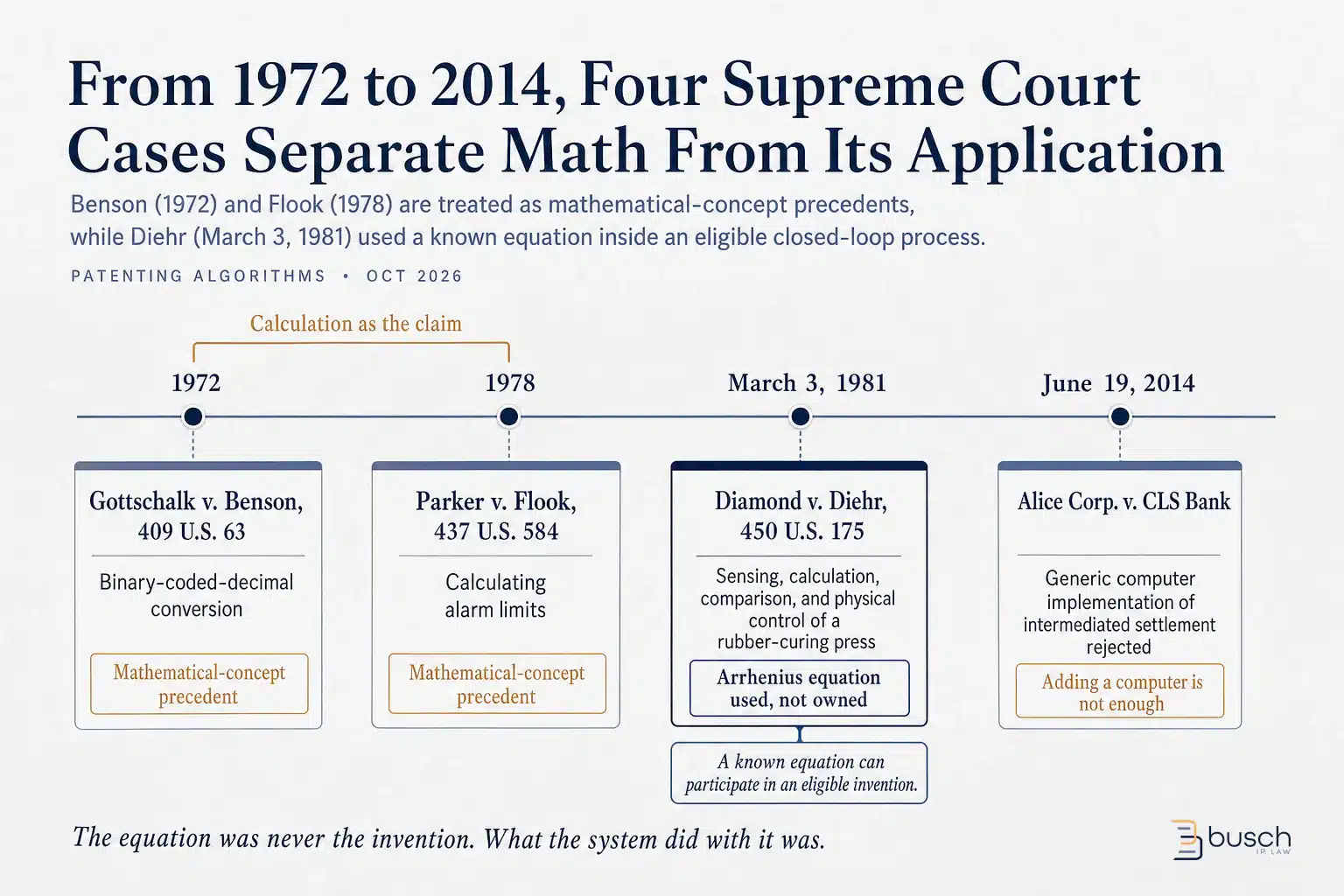
From 1972 to 2014, Four Supreme Court Cases Separate Math From Its Application. Source: U.S. Supreme Court, 1981, Diamond v. Diehr, 450 U.S. 175; U.S. Supreme Court, 2014, Alice Corp. v. CLS Bank International
The USPTO rejects patent claims directed to a mathematical concept or bare mathematical steps, which is why many software patents fail. Gottschalk v. Benson (1972, binary conversion) and Parker v. Flook (1978, alarm limits) both refused claims that would let the applicant own the math.
The office grants claims that put mathematical formulas to work, which is how algorithm patents survive. In Diamond v. Diehr (1981), a computer recalculated cure time from mold temperature using the Arrhenius equation and opened the press on signal. The equation stayed free, and the process was eligible.
Alice Corp. v. CLS Bank International (2014) rejected a generic computer implementation of a financial settlement concept. Ask what your algorithm changes in a system, not only what it computes, because patentable inventions show a concrete effect.
Alice/Mayo asks what a claim is directed to, not whether it contains math or involves human activity. An equation can pass. Generic computer wrapping fails.
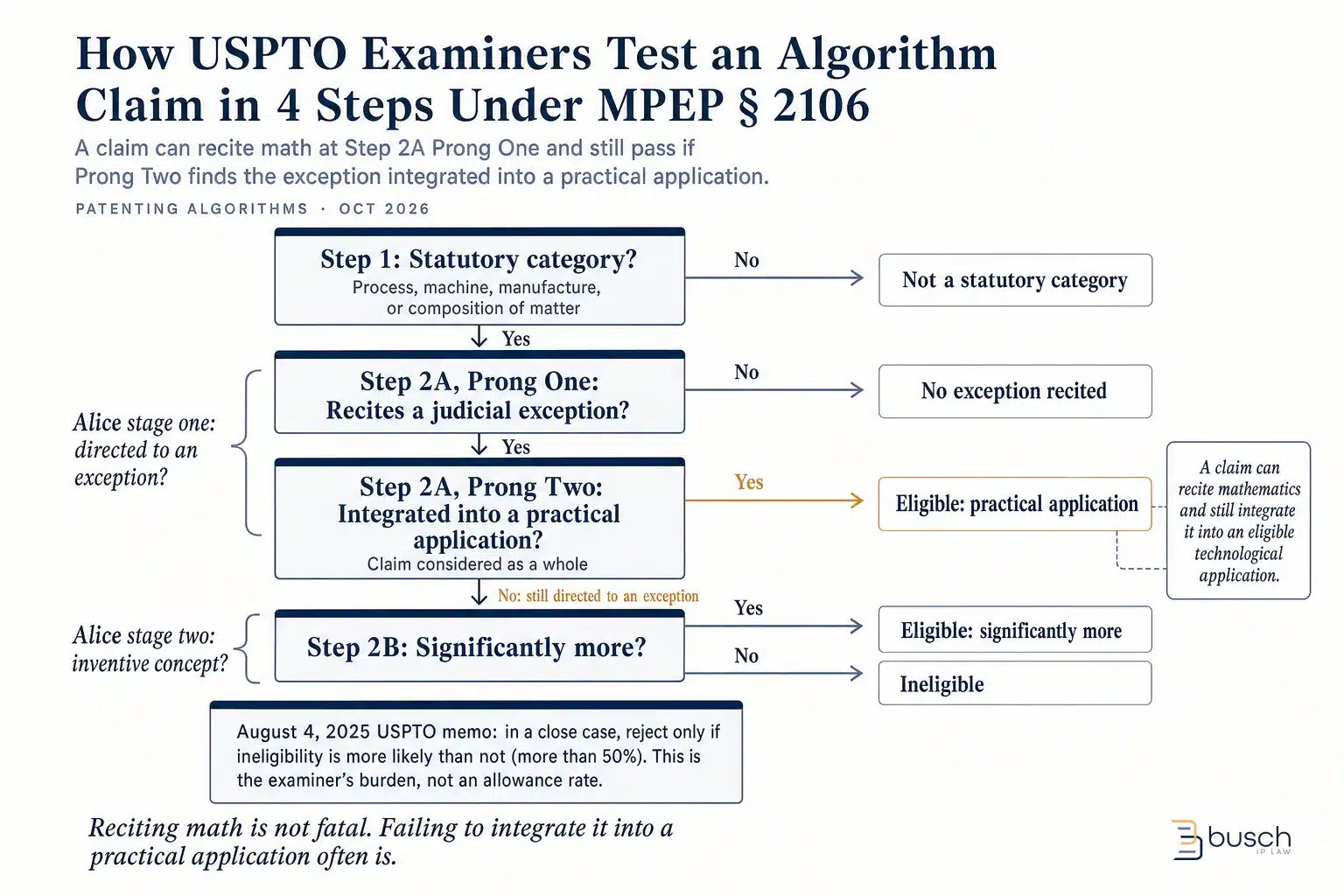
How USPTO Examiners Test an Algorithm Claim in 4 Steps Under MPEP § 2106. Source: USPTO, MPEP § 2106, current online examination guidance; USPTO, August 4, 2025 memorandum
Mayo Collaborative Services v. Prometheus Laboratories (2012) and Alice (2014) set a two-step test:
Patent examiners at the U.S. Patent Office apply that test under MPEP § 2106 as Step 1 and Step 2, with Step 2 divided into Step 2A (a two-prong inquiry) and Step 2B:
In Ex parte Desjardins (September 26, 2025, later precedential), the Appeals Review Panel vacated a § 101 rejection of machine learning algorithm training. A September 29, 2026 USPTO memorandum reaffirms that optional Subject Matter Eligibility Declarations under 37 C.F.R. § 1.132 can record technical-improvement evidence.
Yes, when the claims capture a specific improvement to how a computer or technical system operates, solving a technical problem through technical innovation. The improvement must come from a claimed mechanism, not just a faster result.
In Enfish, LLC v. Microsoft Corp. (2016), the Federal Circuit reversed a § 101 invalidity ruling on claims covering a self-referential database table. The specification tied that structure to faster searching and smaller memory requirements. Tie each benefit to the claimed structure.
The USPTO's July 2024 artificial intelligence (AI) eligibility examples show why the output step matters. In Example 47:
Claim what the system does with the result.
In Recentive Analytics, Inc. v. Fox Corp. (April 18, 2025), the Federal Circuit affirmed dismissal of claims from four patents applying generic machine learning to television scheduling and network maps. Speed gains from existing machine learning were not a technical improvement, a warning for AI systems generally.
Drafting cannot make an abstract idea patentable, but it decides whether your technical process appears in the claim. These hypothetical claims are simplified, not filing-ready.
A startup's inference server caches tensor blocks in GPU memory. It uses per-block reuse distance and request type to evict low-value blocks before least recently used (LRU) eviction would. Proving fewer misses requires real measurements.
A computer-implemented method comprising receiving access data, calculating an eviction score using a scoring function, ranking items according to the score, and outputting the ranking.
Nothing touches memory, so the computer merely hosts arithmetic. In McRO, Inc. v. Bandai Namco Games America (2016), lip-sync claims survived by reciting particular rules using phoneme sequences and timing, not computer automation.
A method of managing a tensor-block cache in GPU device memory, comprising maintaining per-block access-history and request-type records, deriving a reuse-distance value, computing an eviction priority from that value and request type, evicting selected blocks before the next inference operation when a predicted admission would exceed an occupancy threshold, and updating a residency table used to locate blocks.
This applies Enfish logic to a cache. It recites a particular memory operation with defined inputs, an eviction trigger, and a state change.
A December 5, 2025 USPTO notice says claims must reflect the disclosed improvement, apparent to a skilled person from the specification, where your benchmarks and baseline belong.
This strengthens eligibility but predicts no grant. The claim must still be novel and non-obvious under 35 U.S.C. §§ 102 and 103.
To patent an algorithm, document the improvement, search the prior art, and file before any public disclosure. Expect to argue eligibility during examination at the United States Patent and Trademark Office.
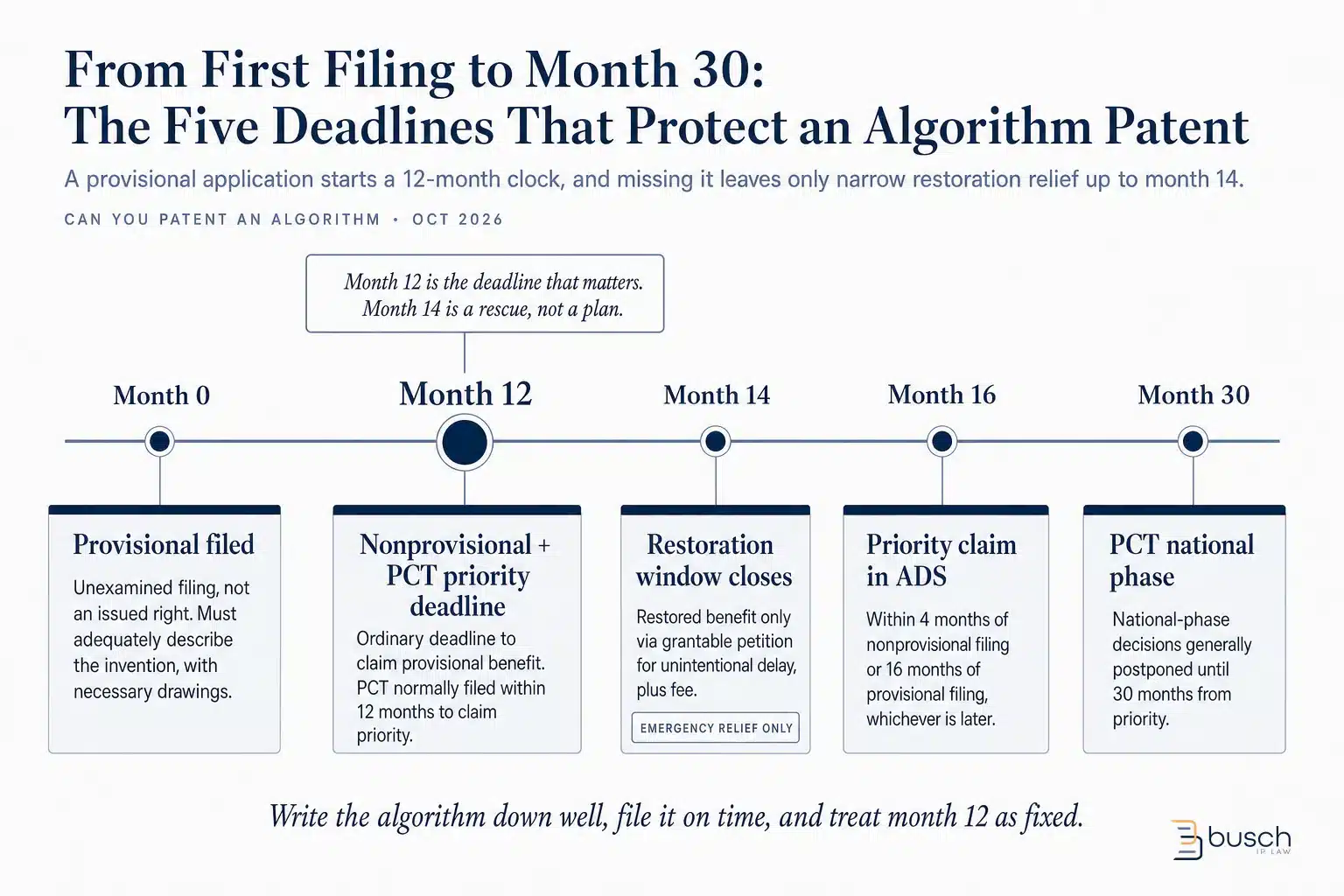
From First Filing to Month 30: The Five Deadlines That Protect an Algorithm Patent. Source: USPTO, current provisional-application guidance, accessed 2026; WIPO, current PCT FAQ, accessed 2026
Before drafting, gather architecture diagrams, pseudocode, the baseline you beat, and benchmark data with test conditions. Add a one-page memo on what was broken, what changed, and what improved. It feeds the § 101 argument and the specification.
Prior art includes issued patents, published patent applications, arXiv papers, and public open source repositories. A patent search, run through Google Patents or the USPTO's Patent Public Search advanced search, shows whether your novel element survives and where to aim claims. Thorough patent searching costs far less than drafting claims you cannot get. Our patent law team, including a registered patent attorney, runs it before drafting.
The U.S. has been first-inventor-to-file since March 16, 2013. Inventor-originated disclosures made within one year before filing are excepted from U.S. prior art. Early disclosure can still defeat patent rights in countries without a general grace period.
A provisional application holds a priority date for 12 months. It is never examined and covers only what it adequately describes. It permits a patent pending mark, which gives notice but is not an enforceable right, and a patent number only issues after the patent application process concludes.
Five deadlines then apply:
Check the current USPTO fee schedule before budgeting, and file through Patent Center.
Patent the algorithm if competitors could see or rebuild it, since intellectual property protection differs by tool. Keep it secret if it never leaves your infrastructure.
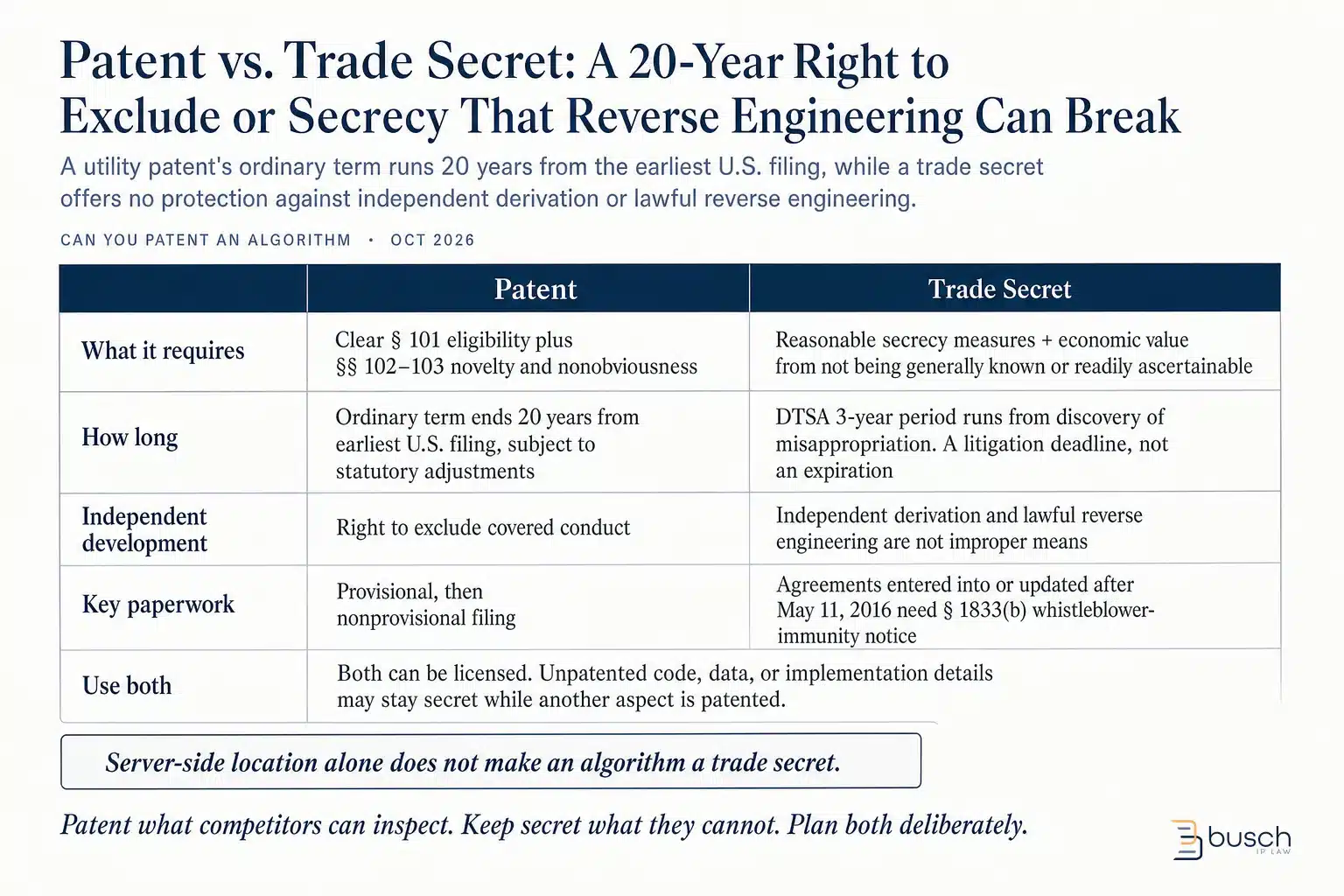
Patent vs. Trade Secret: A 20-Year Right to Exclude or Secrecy That Reverse Engineering Can Break. Source: U.S. Congress, 2024 U.S. Code edition, 18 U.S.C. §§ 1833, 1836, 1839 and 35 U.S.C. § 154; USPTO, 2023, Trade Secret Intellectual Property Toolkit
A patent's right to exclude ends 20 years from the earliest non-provisional filing under 35 U.S.C. § 154. A trade secret lasts while secrecy holds, but lawful reverse engineering and independent derivation are not misappropriation under 18 U.S.C. § 1839.
The Defend Trade Secrets Act, enacted May 11, 2016, protects economically valuable information that is not generally known and is reasonably kept secret, typically through access controls, NDAs, and IP assignment agreements. Employee and contractor agreements need the § 1833(b) whistleblower immunity notice, or employers forfeit exemplary damages and attorney's fees against those individuals.
The USPTO trade secret toolkit notes you can patent one aspect while keeping implementation details secret.
See our patent law FAQ library for more answers.
AI inventions, including some AI algorithms, can earn intellectual property rights through patents when claims cover a specific technical implementation, not just the model's math. Generic machine learning failed in Recentive, while the Desjardins training method cleared § 101. The USPTO's November 28, 2025 inventorship guidance still requires a human inventor.
No. Under copyright law, copyright covers your source code, but 17 U.S.C. § 102(b) excludes any idea, procedure, process, system, or method of operation. See trademark law for product names and how to report copycats on Amazon for copied listings.
Yes, if it is claimed in technical form showing an inventive step, which is how the European Patent Office reviews it. Article 52 of the European Patent Convention excludes mathematical methods and computer programs (called computer programmes in some texts) "as such," not algorithms that contribute to a technical invention.
It can. Public code or papers become prior art, and the U.S. one-year exception covers only inventor-originated disclosures, which many patent offices do not recognize. Europe's Article 55 exceptions are narrow, so file at least a provisional first.
A utility patent generally lasts 20 years, and utility patents are the usual vehicle for algorithms, with a term that runs from the earliest non-provisional filing, plus any adjustment, if maintenance fees are paid at 3.5, 7.5, and 11.5 years after issuance. Design patents run 15 years from grant (see the term comparison and why packaging designs are filed early).
Yes. Defendants can raise § 101 in district court, as Recentive shows, so a patent owner should expect eligibility fights. Post-grant review at the Patent Trial and Appeal Board, unlike inter partes review, allows eligibility challenges if filed within nine months of grant.
A demo, paper, or GitHub push can start disclosure clocks, and math-only claims invite § 101 rejections. Document the technical improvement, search the prior art, and file with the United States Patent Office before going public.
Then draft claims around the mechanism your system actually changed. No firm can promise that a given algorithm will be found eligible or that an application will be allowed.
Before a launch, paper, or raise, talk with experienced patent attorneys and book your Free Strategy Session.
Attorney Advertising. Prior results do not guarantee a similar outcome.
This article provides general information, not legal advice. Reading it does not create an attorney-client relationship. Patent eligibility depends on the specific facts and claims, and no outcome is guaranteed.
This article is for general informational purposes only and is not legal advice. Reading it does not create an attorney-client relationship with Busch IP Law LLC. Intellectual property law is fact-specific, and USPTO rules, fees, and deadlines change. Please speak with a licensed attorney about your specific circumstances before acting.
Jake Busch, Founder & Partner, Registered Patent and Trademark Attorney, Busch IP Law
Igor Ozeruga, Partner, Registered Patent and Trademark Attorney, Busch IP Law

© 2026 Busch IP Law
| View Our Disclaimer | Privacy Policy
Law Firm Website Design by The Modern Firm
