

Executive Summary · ~9 min read
You cannot patent an app idea, only the specific technical way your app works, and a public launch before filing starts a one-year U.S. clock and can end European patent rights. Knowing early when a patent is the wrong tool, and what copyright, trade secrets, or trademarks cover instead, protects both your app and your runway.
One year
U.S. grace period after a qualifying inventor disclosure before patent rights are lost
12 months
How long a provisional application holds your priority date before conversion
20 years
Maximum utility patent term, measured from the non-provisional filing date
A patent is not always the right tool. Apps that win on brand, content, or user experience gain little from utility patents and lean on trademarks and copyright. Hidden ranking, fraud, or pricing algorithms can stay trade secrets indefinitely with NDAs and access controls, though secrecy will not stop reverse engineering. Fast-changing features may also become obsolete before patent examination ends.
Under 35 U.S.C. § 101 and the Alice/Mayo two-step test, adding "on a computer" to an abstract idea does not make it patentable. Claims must target a specific technical improvement, like Enfish's self-referential database. Copyright protects code but not functionality: in Google v. Oracle, copying about 11,500 lines of API declaring code, roughly 0.4% of the API, was fair use.
Written by Jake Busch and Igor Ozeruga, Registered Patent and Trademark Attorneys at Busch IP Law.
Jake Busch is the founder of Busch IP Law and a Registered Patent and Trademark attorney with a background in chemistry. He helps startups, product companies, and e-commerce brands protect what they build, drawing on more than a decade of intellectual property experience at law firms and as corporate general counsel. Jake earned his J.D. from Case Western Reserve University School of Law with a concentration in intellectual property, along with a B.A. in Chemistry and Political Science from Case Western Reserve. He is admitted in Ohio and before the U.S. Court of Appeals for the Federal Circuit.
Igor Ozeruga is a partner at Busch IP Law, a Registered Patent and Trademark Attorney (Reg. No. 72,399), and a former electrical engineer. His practice focuses on software, artificial intelligence and machine learning, and electrical engineering. He has prepared and prosecuted patent applications for many AI and software inventions and has extensive experience overcoming § 101 patent eligibility rejections. Igor earned his J.D. from the University of Akron School of Law and a B.S. in Electrical Engineering, magna cum laude, from Cleveland State University. He is admitted in Ohio and before the U.S. District Court for the Northern District of Ohio, and is recognized in Best Lawyers: Ones to Watch for Patent Law 2027.
You cannot patent an application idea, but you can often patent the specific technical way your mobile application works. A concept like "an app that matches dog walkers with owners" gets no protection. A new, non-obvious mechanism behind it, a unique technical solution, can qualify when it is claimed correctly. This guide covers U.S. federal law administered by the United States Patent and Trademark Office (USPTO), the agency that handles both patents and trademarks.
You can patent an app's technical implementation, not its idea. A USPTO patent temporarily excludes others from making, using, or selling a claimed invention.
Under Supreme Court precedent interpreting 35 U.S.C. § 101, abstract ideas are unpatentable. In Alice Corp. v. CLS Bank International, 573 U.S. 208 (2014), the Supreme Court held generic computer implementation adds no inventive concept.
It must solve a technical problem specifically, like a sync protocol that cuts battery drain, and be novel (§ 102) and non-obvious (§ 103). Every stage of the patent process, a slow legal process, turns on this showing.
Skip patents when rivals could copy your value without copying technical methods, because patent protection reaches only what the claims describe, and the legal protection of a patent stops there.
Brand- or content-driven apps gain little from utility patents. The USPTO's comparison assigns names to trademarks and expression to copyright. See why your brand needs trademarks. Interfaces may merit design patents, unlike plant patents, which cover only new plant varieties.
Hidden ranking, fraud, and pricing algorithms can remain trade secrets indefinitely, and a trade secret needs no filing with the USPTO. 18 U.S.C. § 1839 requires value from secrecy plus reasonable measures. Secrecy won't stop reverse engineering or independent development.
Features may expire before examination ends, since the patent application process can take significant time, often years, at the patent office. Disclosure over a year before filing exceeds the MPEP § 2153 grace period and can bar patents.
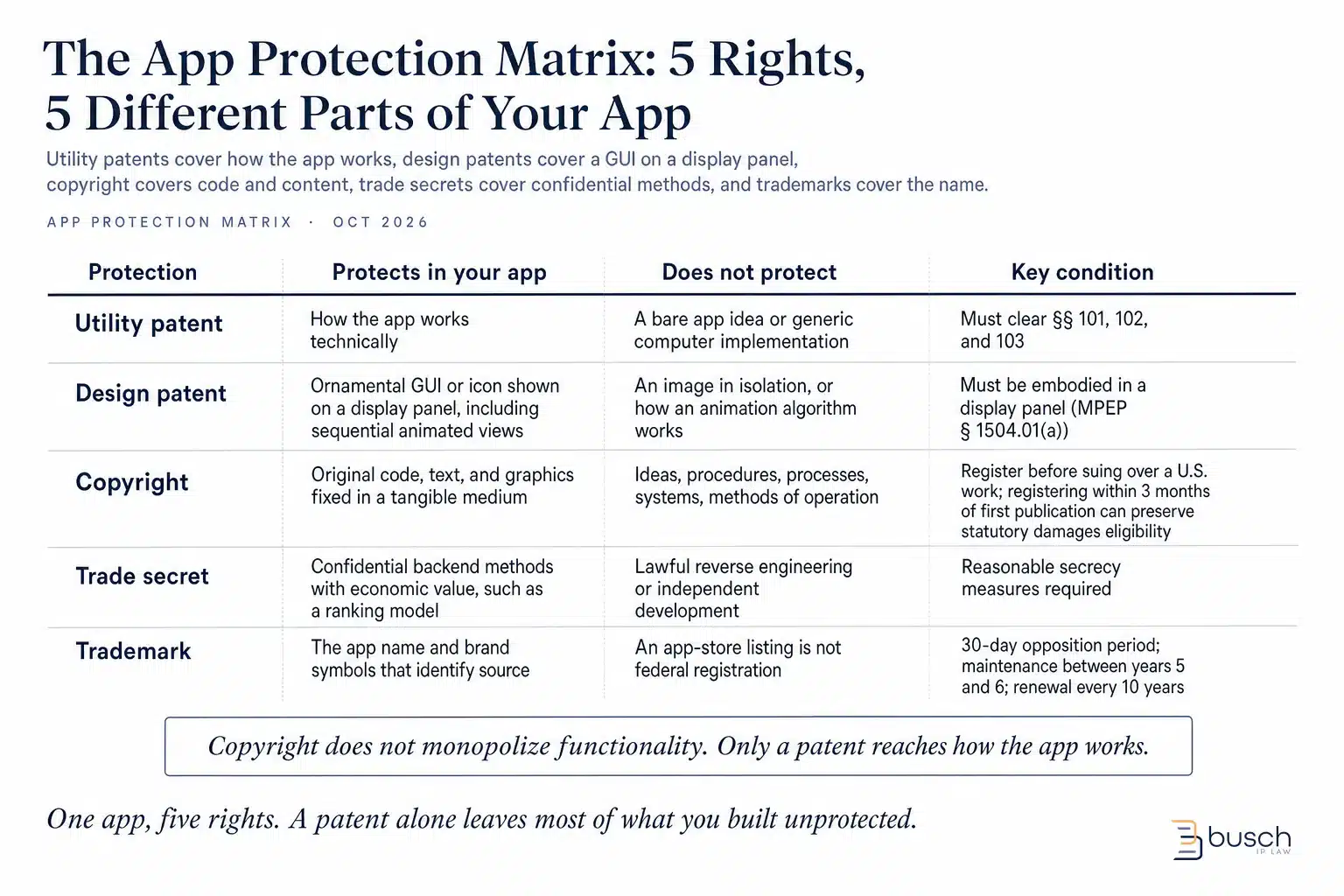
The App Protection Matrix: 5 Rights, 5 Different Parts of Your App. Source: USPTO, Trademark, patent, or copyright, verified 2026; USPTO MPEP § 1504.01(a), revision 2024; U.S. Copyright Office, December 2025; USPTO Trademark Registration Toolkit, verified 2026
| App component | Best-fit protection | What it covers |
|---|---|---|
| Core technical method or architecture | Utility patent | How the app works |
| UI design and icons | Design patent | Ornamental appearance |
| Source code and content | Copyright | Expression, not functionality |
| Confidential algorithms and models | Trade secret | Value kept secret |
| App name and logo | Trademark | Brand and source identity |
Utility patents cover functional methods for 20 years from non-provisional filing (35 U.S.C. § 154). Design patents cover ornamental appearance, including some AR/VR interfaces (USPTO supplemental guidance), for 15 years from grant (35 U.S.C. § 173, MPEP § 1505). See how utility and design patents differ. File early, as for product packaging.
Copyright protection covers fixed software code and content, not methods of operation (17 U.S.C. § 102(b)). In Google LLC v. Oracle America, Inc., 593 U.S. 1 (2021), the Supreme Court held that Google's copying of about 11,500 lines of Java API declaring code, roughly 0.4% of the API, was fair use. Under U.S. copyright law, suing for copyright infringement generally requires registration (§ 411), and timely registration preserves statutory damages and fees (§ 412).
Trade secrets need NDAs and access controls. Trademark rights arise from use, and registration with the USPTO adds nationwide notice and legal presumptions (USPTO Trademark Registration Toolkit). File 1(a) or 1(b) applications in Class 9 or 42. App Store listings create no registered rights, so clear your name before launch. See our trademark page.
Yes, when claims target a specific technical improvement rather than an abstract idea. The Alice/Mayo framework, from Mayo Collaborative Services v. Prometheus Laboratories (2012) and Alice, governs § 101 patent eligibility.
Step one asks whether a claim is directed to an abstract idea, such as a bare machine translation result described without technical detail. Step two seeks an inventive concept amounting to significantly more. MPEP § 2106 calls these Steps 2A and 2B. Adding "on a computer" won't rescue an abstract claim. The USPTO's December 5, 2025 Desjardins memorandum deems an AI training method preserving earlier-task performance a technical improvement. A September 29, 2026 memorandum covers eligibility declarations.
The MPEP cites several Federal Circuit decisions, including two influential 2016 decisions. Enfish, LLC v. Microsoft Corp. (a self-referential database) and McRO, Inc. v. Bandai Namco (specific lip-sync rules) survived. Electric Power Group v. Alstom failed by claiming data collection, analysis, and display by result alone. Software patents are available. Generic data handling is not.
To patent an app, search prior art, file a provisional, then file a non-provisional within 12 months. This is the basic patent journey for most software founders.
Search Google Patents and USPTO Patent Public Search, which index millions of U.S. patent documents in a searchable patent database. Prior art, including existing patents, under § 102(a)(1) also includes public apps, technical papers, and GitHub repositories. A professional patentability opinion from a patent attorney sharpens claims, and advanced search techniques beyond free patent search sites often surface closer prior art.
Per the USPTO, a provisional is never examined but holds a priority date for 12 months, key under first-inventor-to-file rules since March 16, 2013. Include architecture, data flows, and drawings, since it protects only what it describes. Provisional patents are also cheaper to file than a full utility patent application.
Expect a patent examiner to issue office actions during examination of your non-provisional application. One filing under the Patent Cooperation Treaty (PCT) through the World Intellectual Property Organization reaches 159 contracting states as of August 19, 2026, per WIPO's contracting states list and PCT highlights. National patent offices still grant international patents, and the European Patent Office handles European grants. Fees vary by entity status, claim count, and filing format (see the USPTO fee schedule). Our patent law page outlines each stage.
Complete patent filing of at least a provisional patent application before any public release, and lock down ownership of your code.
An App Store release, public beta, Product Hunt launch, or investor demo without an NDA can count as public disclosure. The U.S. grace period covers qualifying inventor-originated disclosures within one year. Europe generally treats any pre-filing disclosure as prior art under EPC Article 54, and the European Patent Office applies that rule strictly.
Paying a freelancer does not by itself transfer copyright. 17 U.S.C. § 204(a) requires a signed written transfer, and 35 U.S.C. § 261 requires written patent assignments. Get signed IP assignment agreements before you file patent applications or raise.
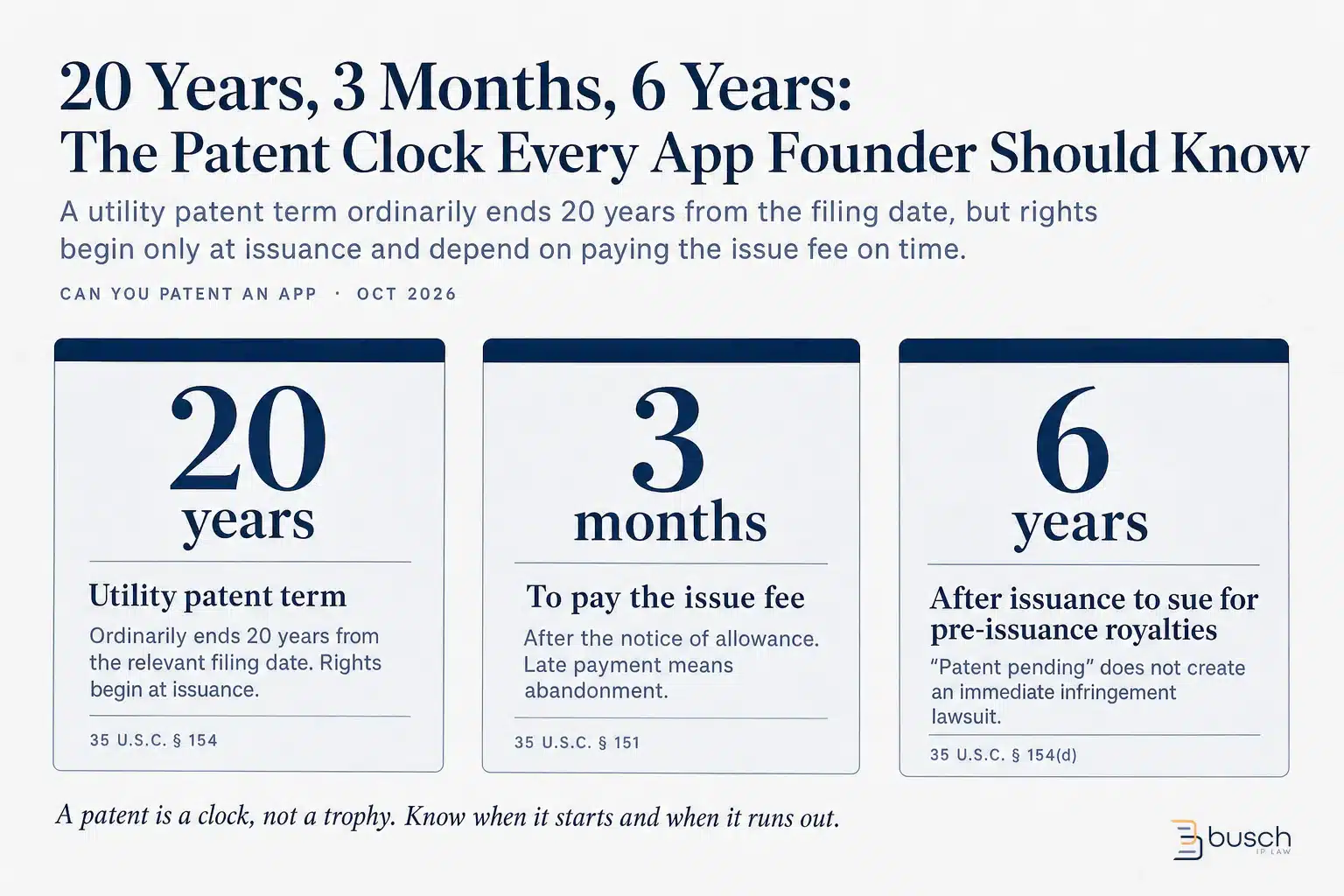
20 Years, 3 Months, 6 Years: The Patent Clock Every App Founder Should Know. Source: 35 U.S.C. § 154; 17 U.S.C. § 412; 35 U.S.C. § 286
Yes, if the application explains how to build it. A bare concept is abstract under § 101, so the application process requires technical detail from the start.
USPTO fees, reduced for small and micro entities, combine with attorney fees, and the patent information on each filing, including any patent number, becomes public later. See the USPTO fee schedule, revised August 14, 2026.
Utility patents last up to 20 years from non-provisional filing. Design patents last 15 years from grant. See our overview of patent terms.
Not if it is already public, since that is prior art. A new, non-obvious improvement may qualify.
No. Under 35 U.S.C. § 154(d), limited royalties for post-publication copying may be recoverable after grant, but under 35 U.S.C. § 286, no recovery is available for infringement committed more than six years before the complaint is filed.
Possibly, if the claims tie the model to a technical improvement. See the USPTO's July 2024 AI examples, 2025 Desjardins guidance, and our patent law FAQ.
A public launch before filing can forfeit patent rights. Busch IP Law's registered patent and trademark practitioners map each part of your app to the right protection. Book Your Free Strategy Session before you launch.
Attorney Advertising. Prior results do not guarantee a similar outcome. No patent application is guaranteed to be granted.
This article is for general informational purposes only and is not legal advice. Reading it does not create an attorney-client relationship with Busch IP Law LLC. Intellectual property law is fact-specific, and USPTO rules, fees, and deadlines change. Please speak with a licensed attorney about your specific circumstances before acting.
Jake Busch, Founder & Partner, Registered Patent and Trademark Attorney, Busch IP Law
Igor Ozeruga, Partner, Registered Patent and Trademark Attorney, Busch IP Law

© 2026 Busch IP Law
| View Our Disclaimer | Privacy Policy
Law Firm Website Design by The Modern Firm
