

Executive Summary · ~10 min read
After the Federal Circuit's April 2025 Recentive v. Fox ruling, applying a generic model to a new field no longer supports a machine learning patent, though claims built on a specific technical improvement, such as a training method, can still be eligible. Filing a detailed provisional before any demo holds your date for 12 months and helps preserve foreign rights you could otherwise lose.
12 months
How long a provisional application holds your filing date, for what it describes
One year
U.S. grace period for your own disclosure; most foreign offices offer none
80,000
Approximate AI-related U.S. utility applications the USPTO counted in 2020
Recentive is continuity, not a new ban. It applies the Alice/Mayo framework under § 101: the court treated iterative training, dynamic updating, and real-time output as inherent to any model. Yet the USPTO's Ex parte Desjardins, precedential November 4, 2025, vacated a § 101 rejection of a training method that penalized changes to parameters important to an earlier task, while the § 103 rejection still stood.
Timing and limits matter as much as drafting. Because most foreign offices offer no grace period, a prefiling demo, arXiv post, or pitch deck can cost foreign rights. Eligible claims still need novelty, nonobviousness, and disclosure under § 112(a). No strategy guarantees a grant, and datasets, hyperparameter recipes, and weights may be better protected as trade secrets when infringement is undetectable.
Written by Jake Busch and Igor Ozeruga, Registered Patent and Trademark Attorneys at Busch IP Law.
Jake Busch is the founder of Busch IP Law and a Registered Patent and Trademark attorney with a background in chemistry. He helps startups, product companies, and e-commerce brands protect what they build, drawing on more than a decade of intellectual property experience at law firms and as corporate general counsel. Jake earned his J.D. from Case Western Reserve University School of Law with a concentration in intellectual property, along with a B.A. in Chemistry and Political Science from Case Western Reserve. He is admitted in Ohio and before the U.S. Court of Appeals for the Federal Circuit.
Igor Ozeruga is a partner at Busch IP Law, a Registered Patent and Trademark Attorney (Reg. No. 72,399), and a former electrical engineer. His practice focuses on software, artificial intelligence and machine learning, and electrical engineering. He has prepared and prosecuted patent applications for many AI and software inventions and has extensive experience overcoming § 101 patent eligibility rejections. Igor earned his J.D. from the University of Akron School of Law and a B.S. in Electrical Engineering, magna cum laude, from Cleveland State University. He is admitted in Ohio and before the U.S. District Court for the Northern District of Ohio, and is recognized in Best Lawyers: Ones to Watch for Patent Law 2027.
In April 2025, the U.S. Court of Appeals for the Federal Circuit upheld the early dismissal of patents that used machine learning to schedule live broadcasts and build TV network maps. Pointing a generic model, such as a neural network, at a new kind of data was not enough. So can you still get a machine learning patent? Yes, when the claim captures a technical improvement instead of a new industry. For artificial intelligence (AI) founders, that changes what you file, not whether you file.
In Recentive Analytics, Inc. v. Fox Corp., 134 F.4th 1205 (Fed. Cir. 2025), the Federal Circuit held that patents applying generic machine learning to new data environments are ineligible under § 101 absent improvements to the models.
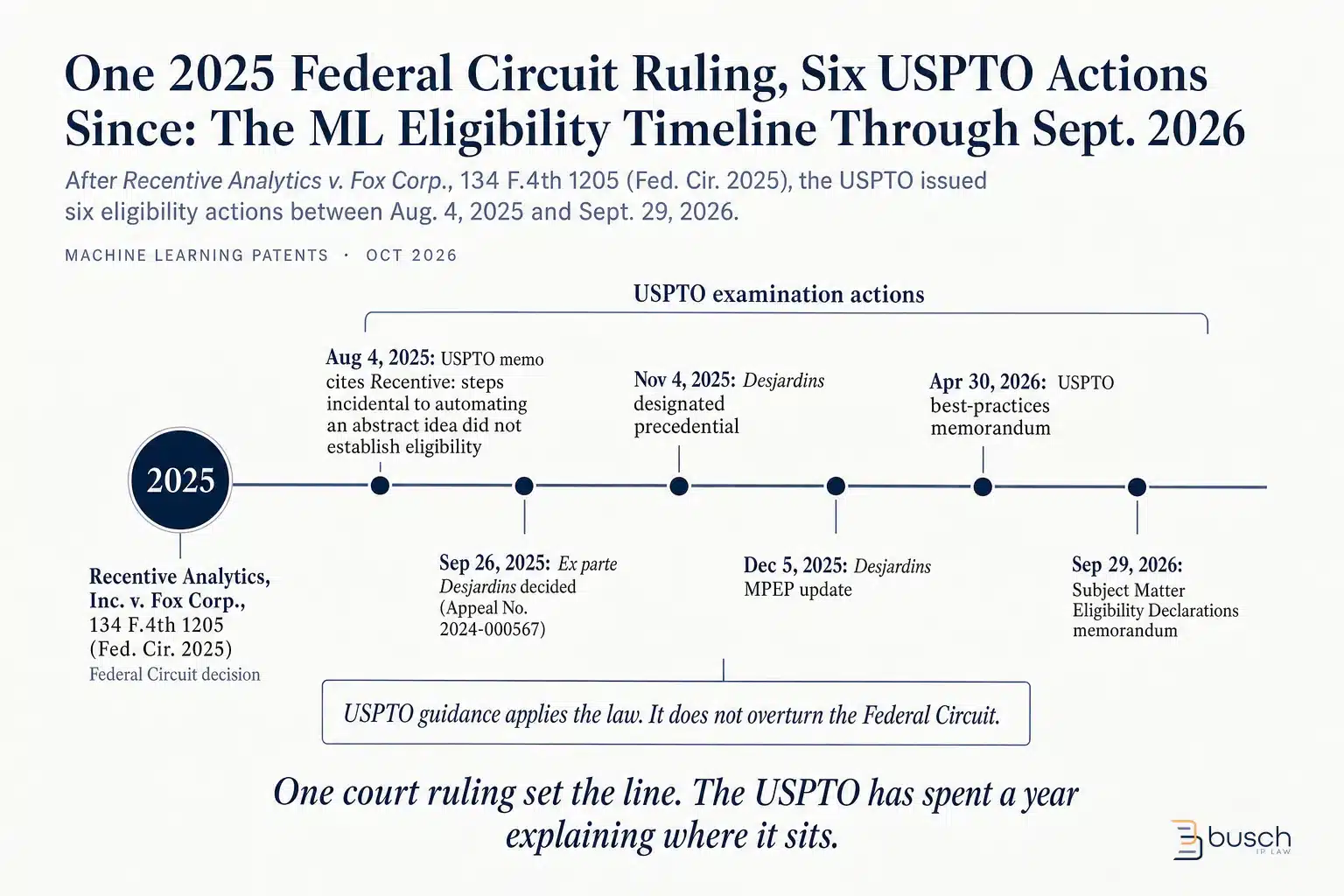
One 2025 Federal Circuit Ruling, Six USPTO Actions Since: The ML Eligibility Timeline Through Sept. 2026. Source: USPTO, August 4, 2025 memorandum; USPTO, December 5, 2025 MPEP update; USPTO current eligibility guidance, updated September 29, 2026
Recentive's patents applied machine learning to live-event scheduling and broadcaster network maps, a known technique in a new field. The United States Patent and Trademark Office (USPTO), also called the U.S. Patent Office, cited Recentive for incidental steps automating an abstract idea in its August 4, 2025 memorandum, one of the guidance documents listed on its eligibility page.
Iterative training, dynamic updating with fresh data, and real-time output did not rescue the patent claims. The court treated them as inherent to any model, though it acknowledged machine learning can produce patent-eligible technological improvements.
New data does not change what a claim is directed to, and patent eligibility turns on that question. Under the Alice/Mayo framework for 35 U.S.C. § 101, an abstract idea plus a standard model lacks an inventive concept, and a claim that is not patent eligible fails at that stage, much like claims limited to mathematical formulas.
The two-step test comes from Mayo Collaborative Services v. Prometheus Laboratories, Inc., 566 U.S. 66 (2012) and Alice Corp. v. CLS Bank International, 573 U.S. 208 (2014):
Recentive applies familiar rules about abstract ideas. The USPTO's December 5, 2025 memorandum cites Enfish, LLC v. Microsoft Corp., 822 F.3d 1327 (Fed. Cir. 2016) (self-referential database table) and McRO, Inc. v. Bandai Namco Games America Inc., 837 F.3d 1299 (Fed. Cir. 2016) (automated lip synchronization) as eligible technological improvements. Machine learning follows the same logic.
The line separates using a model from changing how a technical system works. Sources, the USPTO's July 2024 AI examples and later precedent.
| What the 2025 ruling rejected | Potentially eligible technical approach |
|---|---|
| A standard model in a new field (broadcast scheduling) | A change to how the model or system operates |
| Generic "iteratively train" and "dynamically update" | A specific training mechanism, like Ex parte Desjardins's importance-based penalty |
| Informational output, like a flagged anomaly (Example 47, claim 2) | Output driving technical action, like dropping malicious packets (Example 47, claim 3) |
| Speech separation as generic math (Example 48, claim 1) | A specific separation-and-transcription pipeline (Example 48, claims 2 and 3) |
Eligible claims still need novelty, non-obviousness, and disclosure, and a patent search of a patent database helps confirm the claimed invention is new.
Claim the mechanism producing a technical improvement, usually in a utility patent, and explain it in the specification so patent applications describe the mechanism, not just the result. The USPTO's 2024 Guidance Update (89 Fed. Reg. 58128, effective July 17, 2024) asks whether the claim delivers a practical technological application.
New layer structures, constraint-tied losses, continual learning, and latency-cutting pruning in deep learning are candidates for technical innovation, not safe harbors, and these machine learning techniques should be described concretely. The best example is Ex parte Desjardins (decided September 26, 2025, precedential November 4, 2025). Its claim penalized changes to parameters important to an earlier task during later training. The Appeals Review Panel vacated the § 101 rejection but upheld § 103.
Applied machine learning can qualify when model output changes computer system behavior, as in Example 47's packet-blocking claim, where neural networks classify traffic. Unlike steps a human mind could perform, this ties the output to a technical action. The USPTO's September 29, 2026 memorandum permits optional eligibility declarations explaining improvements. File early and record latency, memory, and bandwidth benchmarks.
Claim the layer with a technical difference a competent ML engineer would not build by default, whether in computer science terms or in your product. The rest supports the specification, which patent examiners read closely.
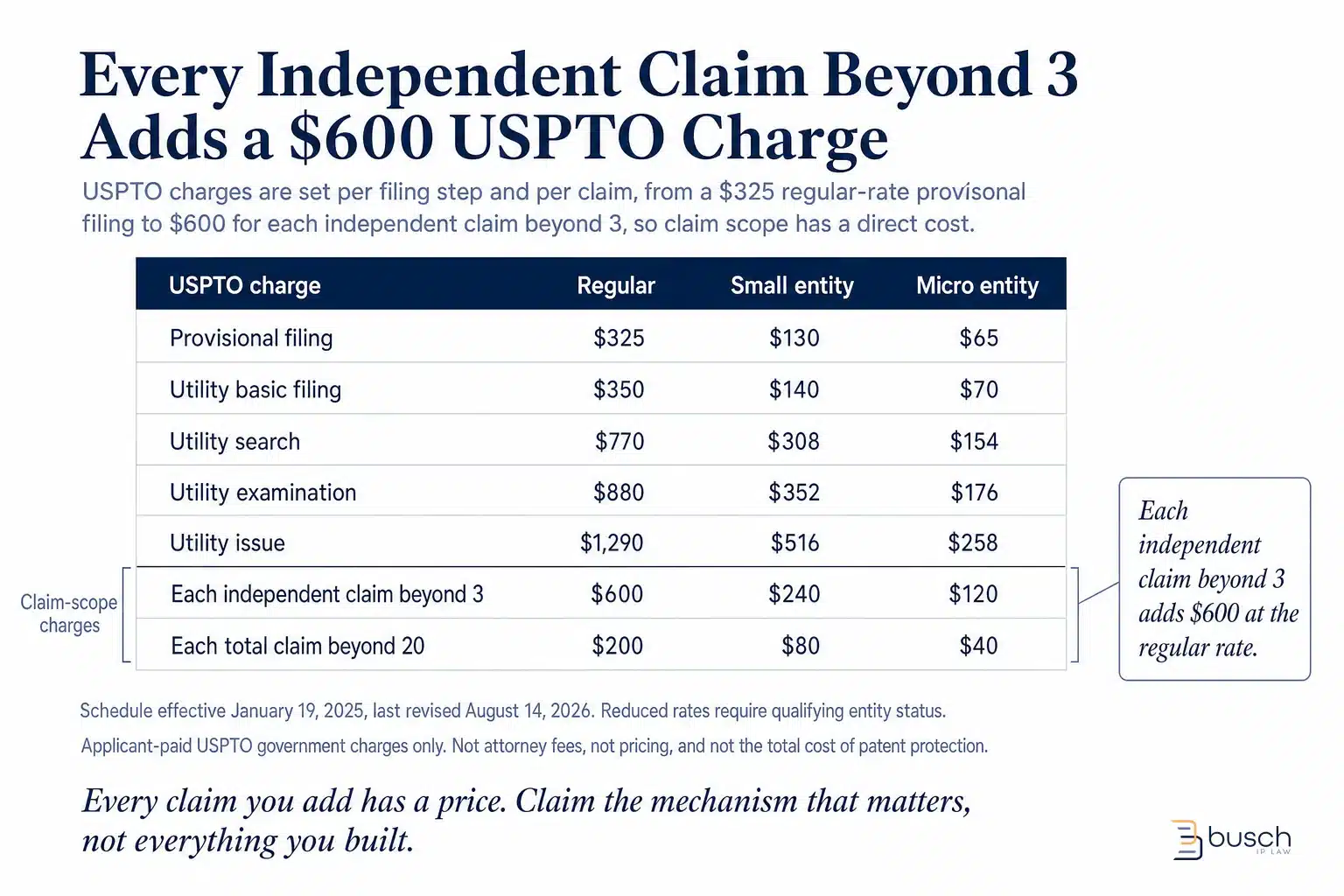
Every Independent Claim Beyond 3 Adds an Excess-Claim Fee at the USPTO. See the current fee schedule for amounts. Source: USPTO, 2026
With your engineers, record each layer's mechanism, inputs, outputs, alternatives, and constraints. This supports the written description, enablement, and best mode that 35 U.S.C. § 112(a) requires.
| Stack layer | Claim potential |
|---|---|
| Model architecture | Technical improvement |
| Training method | Technical improvement |
| Inference serving | Latency, memory, or hardware gains |
| Downstream system integration | When output drives technical action |
| Data ingestion and preprocessing | Depends on specificity |
| Generic model applied to your domain | Weak after Recentive |
Claim at several levels, from the specific mechanism and its dependent claims to the full machine learning system. Under the USPTO fee schedule, each independent claim beyond three adds an excess-claim fee, with reduced small and micro entity rates. Check current fees before filing.
A provisional application holds a filing date for 12 months, but only for subject matter it adequately describes. It is never examined. A detailed provisional patent application cheaply locks a date while you gather benchmarks.
Under 35 U.S.C. § 102(b)(1)(A), the U.S. grace period covers your own disclosure for one year. Other countries' rules vary: some offer six- or 12-month grace periods, while a prior public disclosure can disqualify an invention from European patent protection, so a prefiling demo, arXiv post, or pitch deck can cost foreign rights. Jake Busch, a registered patent and trademark practitioner, tells founders to file before the launch demo, not after.
No claim strategy guarantees eligibility or a grant. The USPTO counted roughly 80,000 AI-related utility applications in 2020, more than 18% of filings.
Patents publish your method in patent documents, which may cost more than it protects if infringement is undetectable. Datasets, hyperparameter recipes, and weights suit secrecy, since they drive model performance without needing disclosure. Per the USPTO's trade secret toolkit, protection requires economic value from secrecy and reasonable efforts to maintain it. Lawful reverse engineering and independent development are not misappropriation.
The European Patent Office, whose European Patent Office database is publicly searchable, asks whether mathematical features contribute to a technical solution (2026 Guidelines, G-II, 3.3.1). Heartbeat detection in a monitoring device qualifies, while natural language processing that classifies documents purely by textual meaning does not. To claim priority to an earlier application, a PCT application must be filed within 12 months of that earlier application's filing date, and it usually enters the national phase at 30 months from the priority date, per the World Intellectual Property Organization (WIPO).
A machine learning invention can be eligible subject matter, but an abstract algorithm alone cannot, because laws of nature and any natural phenomenon are excluded too. The USPTO's 2024 guidance asks whether the whole claim delivers a practical application, and our patent law FAQs cover other requirements.
No. Recentive rejected generic machine learning in new data environments. The USPTO later found a specific training improvement eligible in Ex parte Desjardins.
Proprietary data alone does not make a model eligible. Claim a specific technical method for processing that data or a concrete performance gain.
Yes, if it meets normal requirements and has a human inventor. The USPTO's November 28, 2025 inventorship guidance treats AI as a tool, not an inventor.
Tencent led the World Intellectual Property Organization's 2024 GenAI report with 2,074 generative AI patent families (2014-2023), and IBM led U.S. companies with 601. That ranking covers only GenAI.
A utility patent generally lasts 20 years from the earliest non-provisional filing date, not the provisional. Fees and term adjustments affect duration. Design patents last 15 years from grant but protect appearance, like product packaging, not model function.
Generic "machine learning applied to our industry" claims risk dismissal, and a public demo can cost foreign rights. A provisional buys 12 months. The 14-month restoration window needs a grantable petition, an unintentional-delay statement, and a fee (USPTO).
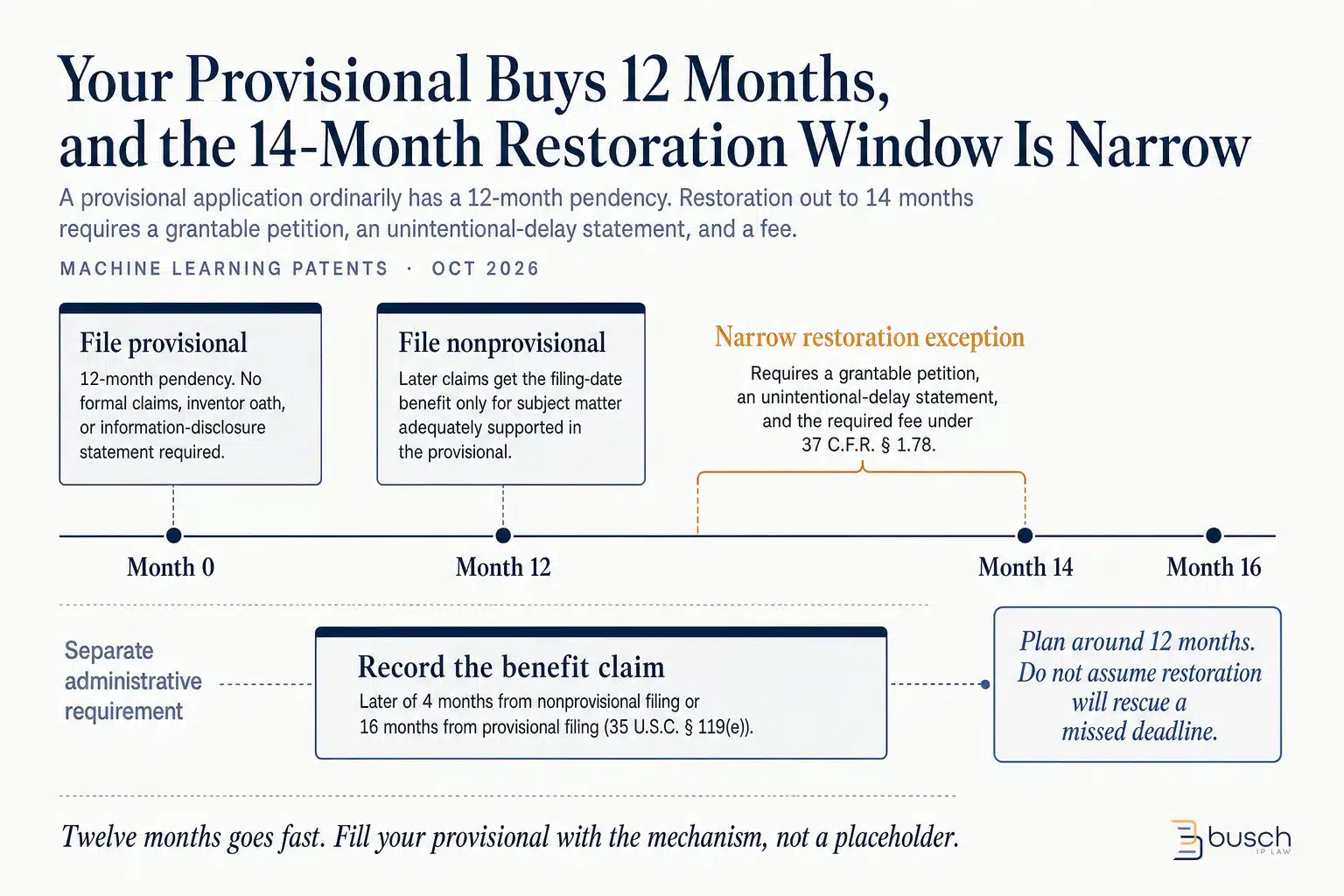
Your Provisional Buys 12 Months, and the 14-Month Restoration Window Is Narrow. Source: USPTO, 2023
Busch IP Law's patent law team finds the claimable layer of your stack and drafts claims around the technical mechanism. Book a free strategy session or read why founders choose Busch IP Law.
This article is general information, not legal advice. It reflects law and USPTO guidance as of October 5, 2026. Attorney advertising. Prior results do not guarantee a similar outcome. Reading this article does not create an attorney-client relationship.
This article is for general informational purposes only and is not legal advice. Reading it does not create an attorney-client relationship with Busch IP Law LLC. Intellectual property law is fact-specific, and USPTO rules, fees, and deadlines change. Please speak with a licensed attorney about your specific circumstances before acting.
Jake Busch Founder & Partner, Registered Patent and Trademark Attorney Busch IP Law
Igor Ozeruga, Partner, Registered Patent and Trademark Attorney, Busch IP Law

© 2026 Busch IP Law
| View Our Disclaimer | Privacy Policy
Law Firm Website Design by The Modern Firm
