

Executive Summary · ~14 min read
Software can be patented in 2026 only when claims capture a specific technical improvement in how the system works. In April 2025, four machine learning patents in Recentive failed that test. Filing a thorough provisional before any public launch secures a 12-month priority window and can preserve foreign rights you might otherwise lose.
4
Machine learning patents held ineligible in Recentive v. Fox on April 18, 2025
80%
Cut on covered USPTO fees for qualifying micro entities (60% for small entities)
12 months
Window after a provisional to file a non-provisional and claim its date
Adding "on a computer" or "using machine learning" does not rescue an abstract claim. In Recentive, four ML patents failed because they applied generic machine learning to scheduling without improving the technology. Enfish's self-referential database table survived as an improvement to computer functionality itself. Results-only verbs like "optimize" read as abstract. The patentable core usually sits in data pipelines, training procedures, or constrained-hardware inference.
The U.S. one-year exception is not a general grace period. Europe's EPC Article 54(2) counts anything made public before filing, so a public GitHub repo, talk, or beta can count against foreign rights. Costs have no single verified figure. Small entities get 60% and micro entities 80% off covered USPTO fees, but startup status alone qualifies for neither, and claims above three independent or 20 total add fees.
Written by Jake Busch and Igor Ozeruga, Registered Patent and Trademark Attorneys at Busch IP Law.
Jake Busch is the founder of Busch IP Law and a Registered Patent and Trademark attorney with a background in chemistry. He helps startups, product companies, and e-commerce brands protect what they build, drawing on more than a decade of intellectual property experience at law firms and as corporate general counsel. Jake earned his J.D. from Case Western Reserve University School of Law with a concentration in intellectual property, along with a B.A. in Chemistry and Political Science from Case Western Reserve. He is admitted in Ohio and before the U.S. Court of Appeals for the Federal Circuit.
Igor Ozeruga is a partner at Busch IP Law, a Registered Patent and Trademark Attorney (Reg. No. 72,399), and a former electrical engineer. His practice focuses on software, artificial intelligence and machine learning, and electrical engineering. He has prepared and prosecuted patent applications for many AI and software inventions and has extensive experience overcoming § 101 patent eligibility rejections. Igor earned his J.D. from the University of Akron School of Law and a B.S. in Electrical Engineering, magna cum laude, from Cleveland State University. He is admitted in Ohio and before the U.S. District Court for the Northern District of Ohio, and is recognized in Best Lawyers: Ones to Watch for Patent Law 2027.
TL;DR. Software is patentable in the U.S. when claims capture a specific technical improvement in how a system works, not the idea or business result. File a thorough provisional before any public launch and stage remaining spend against your runway.
On April 18, 2025, the Federal Circuit held four machine learning patents in Recentive Analytics, Inc. v. Fox Corp. ineligible. The claims applied generic machine learning to event scheduling and broadcast network maps without improving the technology (Federal Circuit opinion). Months later, the USPTO's Patent Trial and Appeal Board designated the Appeals Review Panel decision in Ex parte Desjardins precedential, treating a training method preserving a model's performance on earlier tasks as a technical improvement, and patent eligible (USPTO notice). The panel faulted the Board for equating machine learning with an unpatentable algorithm and wrote: "Categorically excluding AI innovations from patent protection in the United States jeopardizes America's leadership in this critical emerging technology."
That contrast defines software patents in 2026. AI and SaaS inventions succeed when claims capture how the system works, not what the business wants, and that holds for software inventions generally.
This guide explains the legal framework under U.S. patent law and covers:
Worked examples of surviving and failing claims in software patent applications draw on Busch IP Law's USPTO-registered patent attorneys, who focus on software and technology patents.
Yes. Under U.S. law you can patent how software works, claimed as a process, machine, or article of manufacture (USPTO Patent Essentials). Source code, bare computer programs, and business ideas are not patentable, because they fall outside eligible subject matter.
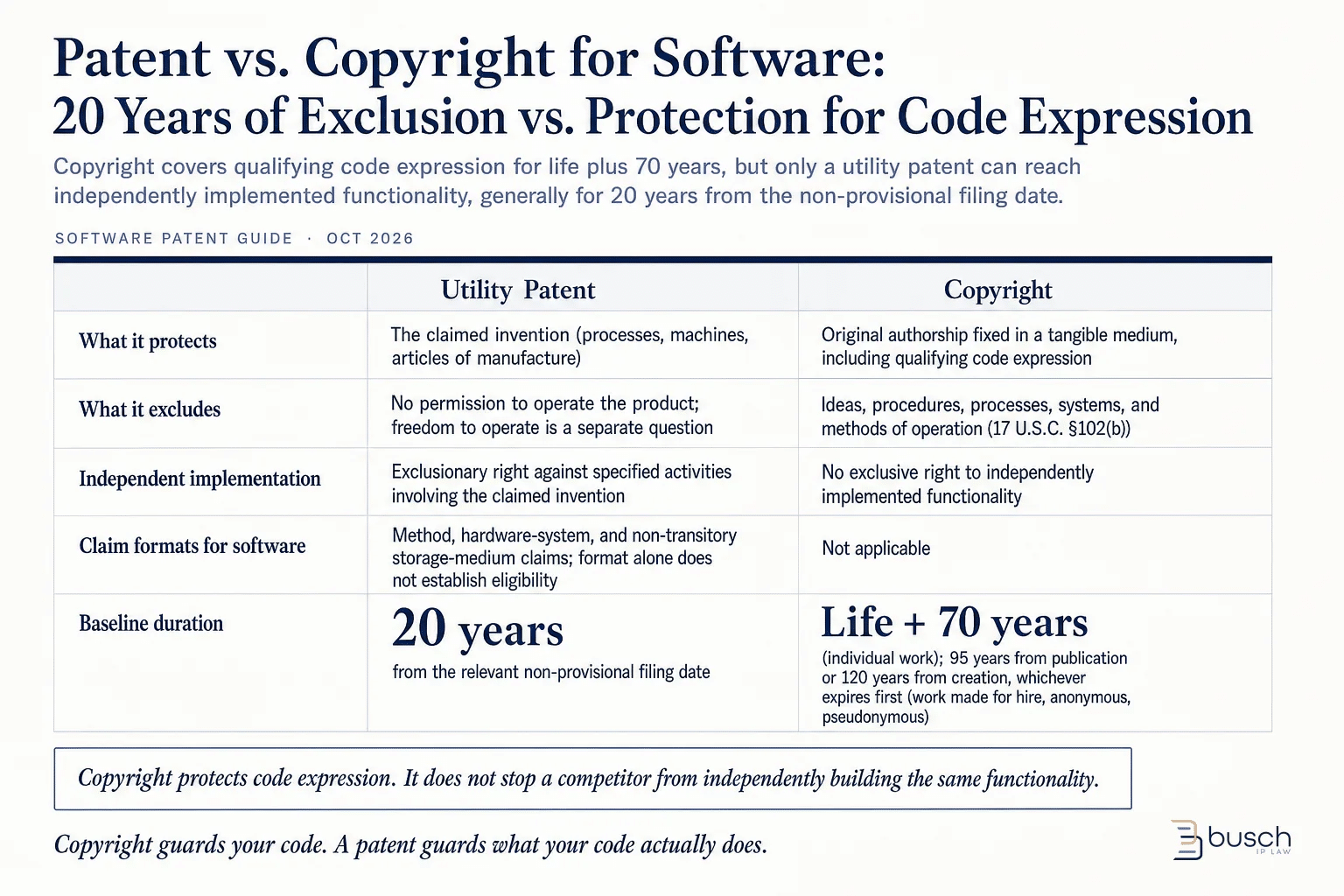
Patent vs. Copyright for Software: 20 Years of Exclusion vs. Protection for Code Expression. Source: USPTO Patent Essentials, 2026; Copyright Law of the United States, December 2025 edition
A software patent claims functional behavior. A deduplicating stream engine could be claimed three ways:
The USPTO's AI eligibility examples use all three. Format never rescues an ineligible claim. Rewriting in Rust or Go does not, alone, avoid the claims.
A design patent protects only a GUI's ornamental appearance, for 15 years from grant (utility versus design patents).
A patent excludes others but grants no freedom to operate, so even a patented invention can infringe someone else's rights, a common surprise for founders new to the patent system.
Copyright protects code as expression once fixed, but under 17 U.S.C. §102(b), it never covers processes, systems, or methods of operation.
Utility patents exclude for 20 years from the earliest non-provisional filing date. Work-for-hire copyright lasts 95 years from publication or 120 from creation, whichever expires first.
Many startups patent the mechanism and copyright the code, because patent scope reaches how the system works. Against clones copying code or app content, copyright registration and DMCA takedowns are usually faster, and registration is required before suing over a U.S. work (online brand protection). Trade secrets suit hidden backend logic that never leaves your servers (see the timing section below).
Software is patentable in 2026 if the claim satisfies §101 under the Alice/Mayo framework, which treats claims to abstract ideas, natural phenomena, and laws of nature as ineligible subject matter when implemented with only routine computing. This is the core test of patent eligibility.
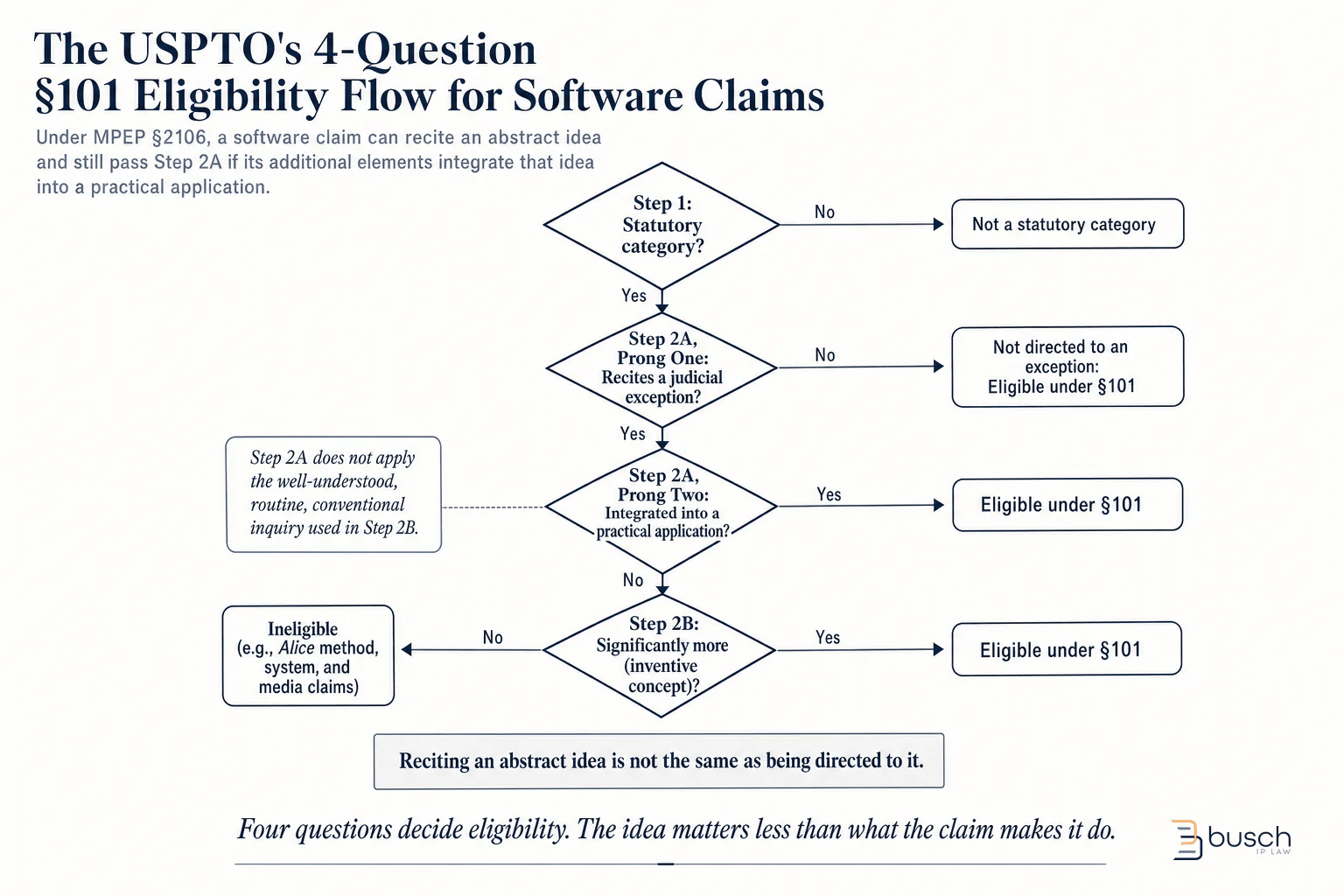
The USPTO's 4-Question §101 Eligibility Flow for Software Claims. Source: USPTO MPEP §2106, current edition; Supreme Court, Alice Corp. v. CLS Bank International, 2014
Alice Corp. v. CLS Bank International, 573 U.S. 208 (2014), applied the two-step test from Mayo Collaborative Services v. Prometheus Laboratories, Inc., 566 U.S. 66 (2012) (Supreme Court opinion):
Each patent examiner applies MPEP §2106 as four questions:
A claim reciting a mathematical formula can still pass at prong two when it is tied to an eligible application.
Recent USPTO guidance:
In Alice, generic processors and storage did no inventive work, so the system and medium claims also failed, even though each claimed invention was framed as a machine. Passing §101 does not establish novelty (§102), non-obviousness (§103, akin to the inventive step required abroad), or adequate disclosure (§112).
The clearest software patent examples turn on whether a claim improved computer operation or merely used ordinary computing.
| Decision | Year | What was claimed | Eligibility outcome |
|---|---|---|---|
| Enfish, LLC v. Microsoft Corp. | 2016 | Self-referential database table | Survived, §101 judgment reversed |
| Alice Corp. v. CLS Bank International | 2014 | Intermediated settlement on generic computers | Ineligible |
| Recentive Analytics, Inc. v. Fox Corp. | 2025 | Machine learning applied to event schedules and network maps, with no claimed technological improvement | Ineligibility affirmed |
Surviving §101 is not a finding of infringement or full validity.
In Enfish, the Federal Circuit reversed the §101 ruling on U.S. Patent Nos. 6,151,604 and 6,163,775. Its self-referential table, defining columns through its own rows, was "an improvement to computer functionality itself" (Federal Circuit opinion). The court still affirmed non-infringement of claim 17.
Losing claims stated a result, claimed no technical effect or technical contribution, and left the mechanism to ordinary computing and existing technology. In Recentive, applying machine learning to do a human task faster, without a specific technological mechanism, did not confer eligibility. Gains in computer performance can support eligibility when they result from a claimed improvement in computer technology. Results-only verbs like "optimize" read as abstract. Two illustrative phrases, not from filed claims:
Patent the mechanism your software engineers built, the technical solution achieved through technical means, not the feature customers buy.
Before any outside spend, have engineers record:
That record maps to the USPTO's test for technological improvements in MPEP §2106.04(d)(1).
In the USPTO's July 2024 AI examples, Example 47's claim 3 is eligible because it drops malicious packets and blocks future traffic in real time. Claim 2, which only outputs anomaly data, is not. Example 48's speech-separation claims reciting specific clustering and masking are eligible.
Inventors are humans who conceived the claimed elements, regardless of title. The USPTO's revised inventorship guidance of November 28, 2025, rescinded its February 2024 AI guidance and treats AI as a tool.
Separately, under 35 U.S.C. §261, assignments must be written (MPEP §301), so collect signed ones from co-founders and contractors early.
To patent software, search the prior art, file a software patent application fully describing the architecture, work through examination, and pay the issue fee after allowance. According to the USPTO, the milestones are:
Publication is the default. Applicants who certify at filing that they will not file abroad or under the PCT can request nonpublication under 35 U.S.C. §122(b)(2)(B)(i). A later foreign filing triggers a notice obligation, so reserve this for U.S.-only markets.
The USPTO recommends classification searching, foreign databases, and non-patent literature. For software, that includes papers, open source repositories, and shipped products. Start with USPTO Patent Public Search and Google Patents. A professional patent search shows how close the nearest reference sits to your mechanism, which shapes claim scope rather than giving a yes or no on whether you have a patentable invention.
A provisional application holds an early filing date for 12 months, and a non-provisional filed in that window can claim its benefit under 35 U.S.C. §119(e). It is never examined and never issues (USPTO). It must describe the invention well enough to support later claims under 35 U.S.C. §112(a).
| Feature | Provisional application | Non-provisional application |
|---|---|---|
| Examined | No | Yes |
| Formal claims required | No | Yes |
| 20-year term | Does not start it | Measured from its filing date |
| Best for | Pre-launch demos while architecture moves | Stable architecture, starting examination |
If you miss month 12, a non-provisional filed by month 14 may regain provisional benefit by petition under 37 C.F.R. §1.78, with a fee and a statement of unintentional delay. The USPTO decides whether to grant it. Treat it as a remedy, not a plan.
Patent examiners issue office actions under §§101, 102, 103, and 112. The response period depends on the action but is commonly two or three months without extension fees, and most can be extended for fees to six months (MPEP §710), the statutory ceiling under 35 U.S.C. §133. Missing it abandons the application. Software applications are often won in interviews and amendments, limited by the specification's technical detail on how the computer processor and other components operate.
Track One prioritized examination targets final disposition in about 12 months for an added fee. Effective July 8, 2025, the USPTO raised its annual cap from 15,000 to 20,000 requests (USPTO Track One). For correspondence received on or after July 20, 2026, foreign-domiciled applicants need a registered practitioner (USPTO memo), who must sign follow-on papers such as the application data sheet and join any examiner interview.
No verified single figure covers every software patent. Cost depends on entity status, claims, filing path, office actions, and maintenance.
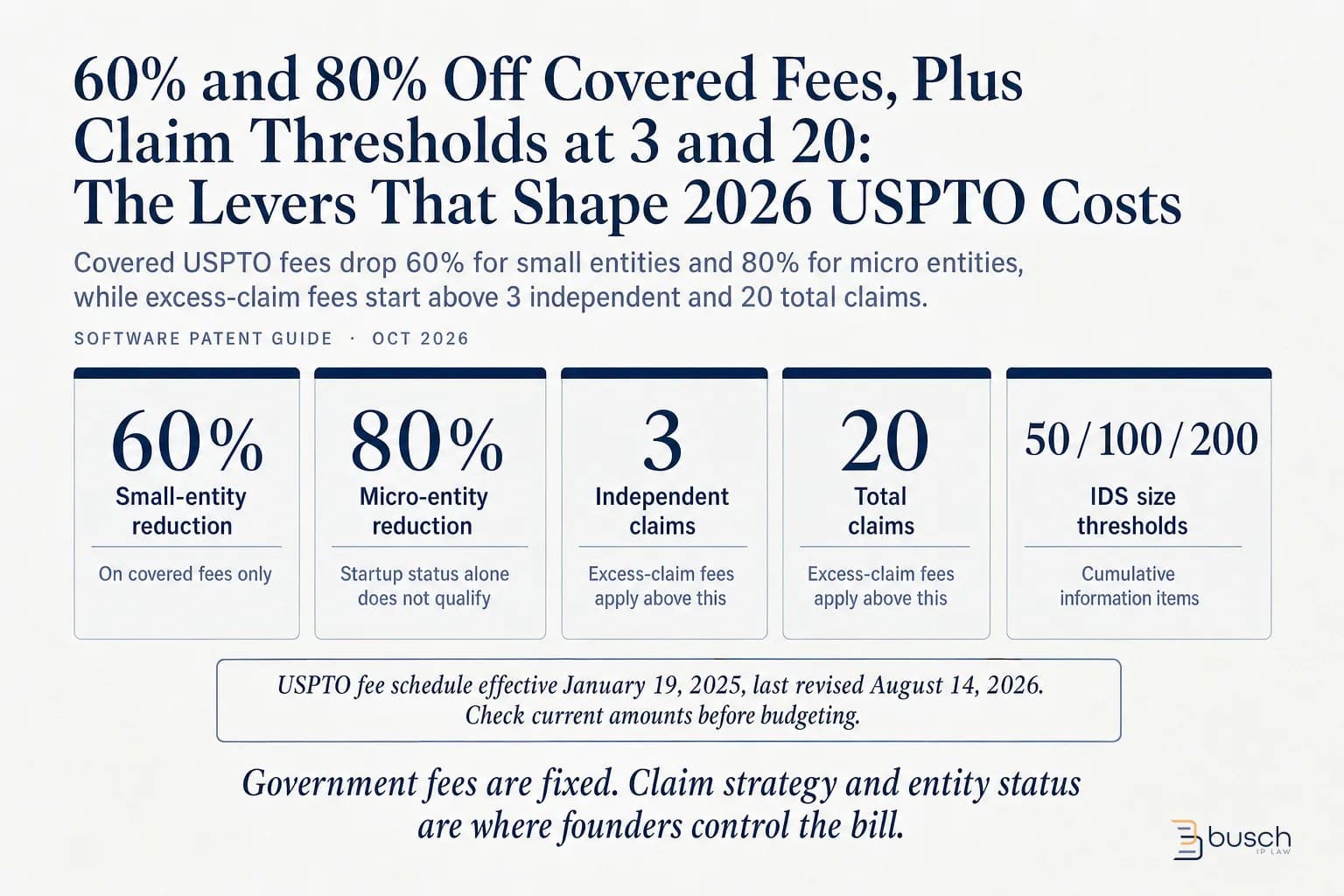
60% and 80% Off Covered Fees, Plus Claim Thresholds at 3 and 20: The Levers That Shape 2026 USPTO Costs. Source: USPTO Fee Schedule, 2026 revision; USPTO patent-fee final rule, 2024, effective 2025
The USPTO fee schedule took effect January 19, 2025 (revised August 14, 2026). Covered fees drop 60% for small entities and 80% for micro entities (fee rule). Startup status alone qualifies for neither. Small entity status turns on headcount and no assignment or license to a larger entity. Micro status adds income and filing-history limits.
Other fee levers:
Attorney drafting and prosecution time for patent applications is the rest. No verified source gives software-specific ranges, so request separate estimates for searching, provisional and non-provisional drafting, office actions, interviews, appeals, and foreign filings.
File before any public disclosure if foreign protection might matter. Wait when a patent would not protect anything durable.
The U.S. is first-inventor-to-file. Under 35 U.S.C. §102(b)(1), disclosures made one year or less before filing are excepted only if they meet the statutory requirements, such as your own disclosures or those by someone who obtained the subject matter from you. It is not a general one-year grace period. Third-party disclosures need separate analysis.
Europe is stricter. EPC Article 54(2) counts anything public before filing, and Article 55 offers narrow exceptions. A public GitHub repo, talk, or beta can count against you. Product appearance raises similar timing issues for design patents for product packaging.
Waiting can make sense when:
Trade secrets need reasonable secrecy, with no patent premium attached, but allow independent development and reverse engineering (USPTO Trade Secret Toolkit). Product names rely on trademark rights instead.
Document your decision either way. Acquirers check IP ownership.
A software patent is a utility patent claiming a software-implemented process, system, or computer-readable medium (patent law FAQs). It must meet eligibility, novelty, non-obviousness, and disclosure requirements (USPTO Patent Essentials).
Costs vary with entity status, claim count, filing path, and maintenance. Qualifying small and micro entities receive 60% and 80% reductions on covered government fees (USPTO fee schedule).
Enfish involved U.S. Patent Nos. 6,151,604 and 6,163,775, whose self-referential database claims the Federal Circuit held were not directed to an abstract idea (Federal Circuit opinion). These are historical examples, not statements about current enforceability.
Yes. Microsoft's 2025 Annual Report describes patent protection for its products, outbound licensing, and cross-license agreements. Microsoft was the Enfish defendant, not the patent owner.
Yes, if the claims recite a specific technical improvement, such as a new training method, rather than using AI to reach a result. Ex parte Desjardins was eligible, but Recentive held ineligible claims that applied machine learning to a new data environment without a claimed technological improvement (Federal Circuit opinion).
Software patents generally last 20 years from the earliest non-provisional filing date, subject to adjustments (patent term by type). Maintenance fees are due 3.5, 7.5, and 11.5 years after grant (MPEP §2506).
Shipping code before filing can forfeit foreign rights, and claims covering the idea rather than the mechanism struggle under §101.
Busch IP Law's registered practitioners focus on software and technology patents within our patent law practice.
Book your Free Strategy Session or call (216) 200-6768 for a staged plan fitting your runway.
This article provides general information about U.S. patent law as of 2026 and is not legal advice. Reading it does not create an attorney-client relationship. Patentability depends on the specific facts of your invention, and no attorney can guarantee that an application will be granted.
Attorney Advertising. Prior results do not guarantee a similar outcome. Busch IP Law LLC, Richfield, OH.
This article is for general informational purposes only and is not legal advice. Reading it does not create an attorney-client relationship with Busch IP Law LLC. Intellectual property law is fact-specific, and USPTO rules, fees, and deadlines change. Please speak with a licensed attorney about your specific circumstances before acting.
Jake Busch, Founder & Partner, Registered Patent and Trademark Attorney, Busch IP Law
Igor Ozeruga, Partner, Registered Patent and Trademark Attorney, Busch IP Law

© 2026 Busch IP Law
| View Our Disclaimer | Privacy Policy
Law Firm Website Design by The Modern Firm
